
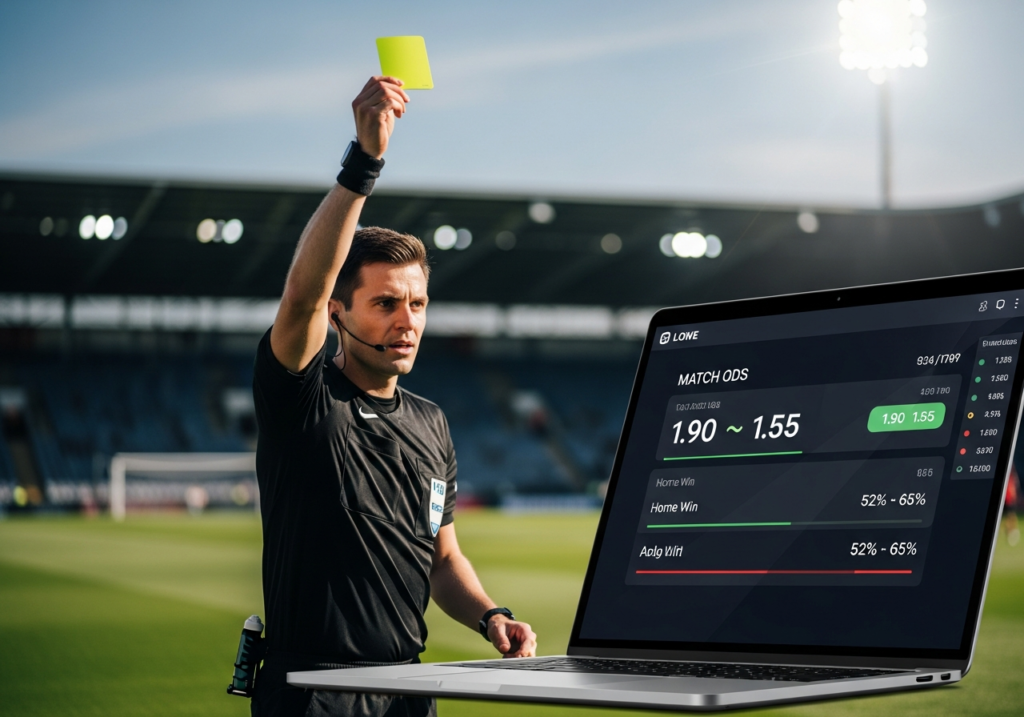
Sports betting in India has experienced explosive growth over the past decade, transforming from a niche activity into a mainstream phenomenon. As more Indians engage in wagering on football, cricket, and other sports, understanding the mechanics that drive odds changes becomes increasingly valuable. One critical yet often overlooked factor is the role of referee and umpire decisions. From a penalty awarded in the 90th minute of an ISL match to a controversial LBW decision in the IPL, official calls directly shape match outcomes and trigger immediate, measurable shifts in betting odds. For serious bettors, recognising these patterns and understanding how sportsbooks price them in can mean the difference between consistent gains and repeated losses. This article explores the empirical evidence, practical frameworks, and actionable strategies Indian bettors can use to integrate referee analysis into their decision-making.
Why Referee Decisions Matter More Than Most Indian Bettors Realise
Referees and umpires are far more than passive rule enforcers—they are active agents whose subjective calls directly alter match momentum, scoring opportunities, and final outcomes. A penalty in football, a red card, a controversial no-ball in cricket, or an overturned LBW via DRS can swing the course of play in seconds. Each of these decisions carries quantifiable implications: a penalty represents a high-probability scoring chance; a red card fundamentally changes team dynamics and tactical flexibility; a no-ball in the final over of an IPL match can mean the difference between a win and a loss.
From a betting perspective, every major referee decision triggers an immediate recalculation of win probabilities. When a penalty is awarded, sportsbooks must adjust their implied probability that the attacking team will score and ultimately win. When a red card is shown, the defending team’s win probability drops sharply because they are now operating with a numerical disadvantage. These probability shifts translate directly into odds movements, particularly in in-play markets where prices update continuously. Sophisticated sportsbooks—especially those serving global markets—increasingly employ dedicated analysts to study referee tendencies, penalty frequencies, card distributions, and home-field bias patterns. This data feeds into their pricing models, adjusting match odds, totals, Asian handicaps, and player performance markets accordingly. While Indian-facing sportsbooks have historically lagged behind global competitors in this sophistication, the trend is shifting as competitive pressure and regulatory frameworks improve.
From Whistle to Odds: How Decisions Translate into Price Changes
Understanding the pathway from a referee’s whistle to an updated odds display helps bettors anticipate and exploit market movements. Consider a concrete example: an ISL match between a home team and visitors, with the score locked at 1–1 in the 85th minute. The home team’s star striker is brought down in the penalty area with minimal contact—a 50–50 call. The referee awards the penalty. Instantly, the sportsbook’s model updates: the home team’s win probability jumps from, say, 48% to 65% (reflecting the high conversion rate of penalties in football). The corresponding odds shift from 2.10 to 1.55, a dramatic compression that reflects increased certainty. Bettors who anticipated this decision or sensed the referee’s lenience earlier in the match may have backed the home team at 2.10; they now face a profitable position. Others, who backed the away team, are suddenly underwater.
In cricket, the mechanism is similarly transparent. Imagine an IPL match where a batter is adjudged LBW in the 18th over, with the score tight and the batting team needing quick runs. If the sportsbook’s ball-tracking model suggests the decision was marginal, it will still reflect the new match state (one fewer batter, a run fewer on the board). If later review evidence suggests the umpire made an error, the odds may overreact—offering value for contrarian bettors. The key insight is that bettors can capture small edges by (1) anticipating which referees make certain types of calls more frequently, (2) recognizing when odds are slow to adjust to new information, and (3) identifying markets where the sportsbook’s model diverges from reality due to referee-related factors.
Indian Betting Context: Regulated vs Offshore Markets
The Indian betting landscape is fragmented, with regulated platforms (where they exist) and a large offshore market operating in parallel. Regulated Indian sportsbooks often have less granular data on referee tendencies than global operators; they may lack historical databases or the analytical firepower to build robust officiating models. Offshore platforms, catering to Indian bettors but licensed in Curacao, Malta, or the UK, often have access to richer data and more sophisticated pricing. This asymmetry creates both challenges and opportunities for Indian punters.
Serious bettors in India should study global referee research and build their own profiles, even if their chosen sportsbook does not explicitly market referee-aware pricing. The knowledge compounds over time: familiarity with how Premier League referees distribute cards, how IPL umpires call wides and no-balls, and how ISL referees handle home-team fouls gives you an edge regardless of your book’s pricing. Regulated platforms may eventually catch up, but until then, independent analysis is a critical advantage. Additionally, understanding the regulatory and integrity environment—which is stronger in international competitions and major Indian leagues than in lower-tier tournaments—helps you avoid compromised matches and maintain discipline.
Types of Referee and Umpire Decisions That Move Betting Odds
Not all referee decisions carry equal weight in betting markets. A harsh foul call in midfield differs from a penalty awarded in the dying seconds; a no-ball in the powerplay differs from a no-ball in the final over. Identifying which decisions move odds most sharply allows bettors to focus their research where it yields the highest return.
- Penalties and Direct Free Kicks (Football): A penalty is a high-probability scoring opportunity (conversion rates exceed 75% in professional football). Awarding or denying a penalty swings win probabilities by 10–20 percentage points, triggering massive odds shifts. Penalties are among the most scrutinised and bet-upon calls.
- Red Cards and Dismissals: A straight red card immediately changes team balance. The expelled team drops to 10 men and faces a severe competitive disadvantage. Win probabilities shift by 15–30 points depending on when in the match the card is shown. These calls affect match odds, spread/handicap markets, and total-goals markets.
- Yellow Cards and Disciplinary Accumulation: Individual yellow cards are lower-impact unless they trigger a second yellow (red). However, cumulative yellows affect player availability and defensive aggression, which influence future overs/halves. Sportsbooks price card markets separately, and bettors tracking high-card referees can identify value in “player total cards” props.
- Offside Decisions and VAR Interventions: Modern football increasingly relies on VAR to overturn or confirm offside calls. A marginal offside decision that is overturned can swing momentum and odds significantly. VAR delays also introduce uncertainty and volatility into in-play markets.
- No-Balls and Wides (Cricket): A no-ball in cricket extends the batter’s opportunity and invalidates the delivery; a wide increases the run count and extends the over. In powerplay overs, an unexpected no-ball might trigger only modest odds shifts. In the final overs of an IPL match, a no-ball can alter the required run rate dramatically and shift odds by 5–15 points.
- LBW and Caught Behind (Cricket): These decisions are often marginal and subject to interpretation (especially pre-DRS). An early-overs LBW decision might shift team odds by 2–5 points; a controversial LBW of a key batter in the 15th over of a T20 can shift odds by 10+ points. DRS overturns add volatility and create opportunities for quick-reacting bettors.
- DRS Overturns and Umpire’s Call: When a review overturns an on-field decision (particularly an LBW), the impact is immediate and measurable. An umpire’s call (where the on-field decision stands despite marginal review evidence) creates frustration but preserves the original odds impact.
High-Impact vs Low-Impact Calls: Prioritising What Bettors Track
Bettors cannot track every decision; focus on those with the largest expected impact on win probability and hence on odds and betting outcomes. Here is a practical ranking for both football and cricket:
- Penalties awarded or denied (football) – typically shifts win probability by 15–25 points; conversion rates are high and the resulting goal is nearly certain.
- Red cards or dismissals of key players (cricket/football) – fundamentally alters team balance; typically shifts probability by 15–30 points depending on timing and player importance.
- LBW of top-order batters in early-to-mid overs (cricket) – removes a key player; typical shift is 8–15 points for first-order batters, smaller for lower-order.
- VAR overturns of goals or penalties (football) – resets the entire momentum and scoreline; 20–30 point swings are common.
- No-ball in final two overs of T20 cricket – extends batting team’s scoring opportunity; typical shift is 5–15 points depending on match context.
- Offside decisions leading to disallowed goals (football) – 10–20 point shift depending on match state and scoreline at the time.
- Marginal foul calls near the penalty box (football) – 5–10 point shifts if the foul is borderline and the resulting penalty is contentious.
- Wide calls in cricket powerplay – typically 1–3 point shifts; more relevant to over/under markets than match odds.
Low-impact decisions (marginal fouls in midfield, soft yellow cards for minor infractions, wides in non-critical overs) are not worth tracking unless you are specialising in niche player-prop markets. Focus your energy on the decisions that move the needle.
Evidence of Referee Bias and Home Advantage that Bettors Can Use
Empirical research across football, cricket, and other sports documents systematic biases in referee and umpire decision-making. These are not random errors but measurable, directional tendencies that bettors can model and profit from.
International studies on Premier League football reveal that home teams receive significantly more favourable decisions than away teams. Research published in peer-reviewed sports analytics journals shows that home referees (and neutral referees) award proportionally more fouls in the home team’s favour, issue fewer yellow cards to home players, and award penalties at a higher rate when the home team attacks. One seminal study found that home teams receive approximately 0.5 more fouls per match in their favour compared to away teams, and this differential varies substantially by referee. Some referees are consistently stricter on visiting teams; others are more neutral.
In cricket, similar patterns emerge. Studies of international cricket and domestic leagues suggest that umpires are more lenient on LBW and caught-behind decisions involving home-team batters, particularly star players. The effect is smaller than in football (cricket’s rules are more objective) but measurable. DRS data has quantified how often on-field decisions are overturned, and some umpires have overturn rates that exceed others by 5–10 percentage points.
The mechanism driving this bias is well-understood. Psychological research on crowd influence, social pressure, and status-quo bias shows that referees, despite their best intentions, are unconsciously swayed by crowd noise, proximity, and the expectation that home teams should win. Experimental evidence using EEG and neuroimaging confirms that loud, hostile crowds trigger stronger defensive responses in officials and reduce their cognitive flexibility—they become more likely to interpret borderline calls in favour of the home team to relieve social pressure.
Importantly, these are not allegations of conspiracy or corruption; they are statistical artifacts of human psychology. Referees are not consciously throwing games. Rather, when faced with a genuinely ambiguous decision (a 50–50 foul, a marginal LBW), the unconscious influence of crowd noise and social context tilts their judgment toward the home team. This systematic bias can be modelled probabilistically.
Home Advantage Mechanisms: Crowd Pressure and Psychological Bias
The psychology behind home-team advantage in refereeing is multifaceted. Loud crowds near the referee create cognitive load and increase stress, which impairs decision-making quality. Studies show that under high noise and social pressure, officials rely more on heuristics (mental shortcuts) and are slower to correct their initial judgments. This favours the status quo: if a foul is ambiguous, the referee is more likely to let play continue (benefiting the home team’s attacking flow) than to award a controversial foul against the home team.
Additionally, referees are subject to negativity bias and social punishment avoidance. A controversial call against the home team triggers immediate, visible crowd hostility—booing, abuse, vocal anger. This negative feedback is psychologically aversive and trains officials to avoid decisions that trigger it. Calls that favour the home team, conversely, are met with cheers and relief. Over the course of a match and a season, these feedback loops unconsciously shape decision-making.
For bettors, the practical implication is straightforward: expect fewer yellow/red cards against home teams, a higher frequency of fouls awarded in the home team’s favour, and slightly more lenient marginal calls in attacking situations. This translates to lower expected cards totals in home-team props, slight increases in expected goals for home teams, and margin-of-victory spreads that favour the home team slightly more than team quality alone would suggest. When you see a sportsbook pricing a home-team win at 1.90 (implied 52.6%), consider whether the underlying team quality and opposition strength truly justify that implied probability or whether home advantage has been underpriced.
Bias Toward Favourites and Big Clubs
Beyond home-field effects, research suggests that referees extend lenient treatment to favourites and established clubs. College football studies have documented that heavily favoured teams receive more penalty yards, fewer negative calls, and more “benefit-of-the-doubt” decisions compared to underdogs. The mechanism is twofold: (1) confirmation bias—referees unconsciously expect favourites to play more fairly because they are high-status teams, and (2) reputational incentives—if a referee makes a controversial call against a star team or a club with a large fanbase, they face disproportionate backlash.
In the Indian context, similar dynamics likely apply to the IPL and ISL. The “Big Three” in IPL (Mumbai Indians, Royal Challengers Bangalore, Kolkata Knight Riders) have massive fanbases, sponsorship value, and broadcast reach. An umpire making a marginal LBW decision against Virat Kohli faces potential social media storms and league scrutiny; the same call against a fringe player on a smaller-budget team may pass unnoticed. This creates subtle incentives for umpires to give star players and marquee franchises the benefit of doubt on marginal calls. Over time, this translates into slightly lower dismissal rates for star players and marginally higher scoring rates for big-budget teams.
For bettors, the implication is that underdog teams may face a subtle officiating headwind. If you are backing an underdog at 3.50 odds, consider whether part of that price reflects not only team quality but also subtle bias against them in officiating. Conversely, if a favourite is priced at 1.50, ask whether some of that confidence reflects fair odds or inflated expectations driven by officiation bias.
How Sportsbooks Price Referee Tendencies into Their Odds
Modern sportsbooks, particularly those serving global markets, explicitly model referee and umpire decision-making as a component of their pricing algorithms. Understanding how they do this helps bettors identify where market prices may diverge from reality.
| Referee/Umpire Trait | Typical Data Metric | Odds Market Most Affected | How Books Adjust | What Smart Bettors Do |
|---|---|---|---|---|
| High-card referee | Cards per match (avg 4.5+ vs. league avg 3.2) | Player cards props, match-cards over/under | Increase card totals by 0.5–1.0; adjust player card odds downward (higher odds for props) | Back player card unders; fade card markets when high-card ref assigned |
| Low-penalty referee | Penalties per match (0.3 or less) | Match odds, handicap, penalty prop | Reduce penalty market probability; slightly increase odds on underdog (fewer shooting chances) | Exploit underpriced underdog if opposing team plays attacking football; fade penalty props |
| Home-biased official | Foul differential home vs away (>+2 per match) | Match odds, handicap spreads, corner/foul totals | Adjust home-team odds tighter (lower, reflecting exaggerated home advantage); home-team yellow cards lower odds | Bet away teams at inflated prices; exploit home-team yellow card undervalue |
| High-VAR overturn official | VAR overturn rate (>15% of reviews) | Match odds, goal/penalty props, live odds volatility | Increase odds volatility; widen spreads slightly during VAR reviews | Increase bet sizing when decisions are pending VAR; exploit slow market moves after overturns |
| Lenient official (few reds/harsh calls) | Red card frequency <0.2 per match | Total goals (slightly higher expected), match aggression metrics | Increase total goals lines; reduce red card props | Target total-goals overs; fade red card props |
Sophisticated sportsbooks build referee profiles by aggregating 20–50 historical matches per official, calculating card frequencies, foul distributions, penalty rates, and home-field biases. They then feed these statistics into machine-learning models that adjust market odds in real time when a referee is announced. For example, if an ISL match is scheduled between a top-6 team (favourite) and a mid-table team (underdog), and the assigned referee has a documented history of being home-biased and high-card, the sportsbook will:
- Tighten the favourite’s odds slightly (reducing the overround) to reflect exaggerated home advantage.
- Increase the over/under on yellow cards by 0.5–1.0 card.
- Increase the odds on a red card prop (reflecting higher volatility and stricter officiating).
Smaller or less sophisticated books may not perform these adjustments, creating opportunities for bettors with independent referee data. If you have tracked an official’s tendencies and know they are statistically more lenient than average, you can identify odds that misprice the likelihood of goals, cards, or penalties.
Odds Formats and Risk Perception for Indian Bettors
Indian bettors encounter odds in various formats: decimal (1.50, 2.00), American/moneyline (−200, +150), fractional (1/2, 1/1), and occasionally implied percentages. Behavioural research shows that odds format affects risk perception and betting behaviour. Decimal odds are most intuitive for calculating expected value but can lead to riskier bet sizing if the absolute number is large (3.50 feels like a bigger potential win than 1/2, even though the risk-reward is identical). American odds emphasise favourites (−200 looks scary) and can discourage underdog betting.
For referee-aware betting, the key is to understand true probabilities independent of format. If a sportsbook prices a player red card at 3.50 decimal (implied 28.6%), and your tracking data suggests the true probability is 22% (given the referee’s history and the match context), then 3.50 is value. The format is irrelevant; the underlying probability divergence is what matters. Indian bettors should convert all odds to implied probabilities, compare to their own models (which may integrate referee data), and bet when the sportsbook’s price is favourable.
Referee Data and Metrics Indian Bettors Should Track
Building an edge in referee-aware betting requires systematic data collection and profile creation. Here are the key metrics to track:
- Penalties per match: For referees, track the frequency of penalties awarded across home and away assignments. A referee with an average of 0.8 penalties per match is high-penalty; one with 0.2 is low-penalty. Also track the ratio of home-team to away-team penalties; strong home-biased referees award penalties to the home team at a 2:1 ratio or higher.
- Yellow and red cards per match: Track cumulative cards per match, cards per team, and the ratio of cards to home vs. away teams. Also track cards in specific positions (defenders vs. attackers) to identify if the referee is stricter on a particular play-style.
- Foul frequency and distribution: Count fouls called per match, fouls against home vs. away teams, and fouls in specific pitch zones (defensive third, midfield, attacking third). A referee who calls 20+ fouls per match is whistle-happy; one who calls <12 is whistle-light.
- Average added time: Some referees consistently add 4+ minutes in the first half and 5+ in the second; others add 2–3. This affects late-game betting, especially in in-play markets. Lenient added-time referees benefit attacking teams chasing late goals.
- VAR overturn rate and speed: Track how often the referee checks VAR, how often decisions are overturned, and average review time. Quick, decisive VAR officials reduce odds volatility; slow, deliberate ones increase it.
- No-ball and wide frequency (cricket): Track no-balls per match, wide balls per match, no-balls in specific overs (powerplay vs. death), and no-balls against specific bowlers. High-no-ball umpires effectively extend batting teams’ scoring opportunities.
- DRS overturn rate (cricket): Track how many on-field decisions are overturned by DRS, broken down by decision type (LBW, caught behind, etc.). High-overturn umpires suggest either marginal on-field calls or systematic error.
Building a Simple Referee Profile for Football and Cricket
Creating a usable referee profile requires systematic data collection and basic statistical discipline. Follow this step-by-step process:
- Select a league and timeframe: Choose the ISL, IPL, or a major international competition. Collect match data for the last 20–30 matches in which a specific referee (or umpire) has officiated.
- Extract raw data: For each match, record the referee’s name, teams, home/away status, scoreline, and all instances of key decision types (penalties, cards, fouls, no-balls, LBWs). Use official league records, match reports, or sportsbook betting data if available.
- Calculate rates and differentials: Compute the referee’s average penalties per match, yellow cards per match, fouls per match, and ratio of decisions favoring the home team vs. away team. Also calculate the standard deviation to identify outliers.
- Flag outliers and tendencies: If a referee’s penalty rate is 2+ standard deviations above or below the league average, flag them as “high-penalty” or “low-penalty.” Similarly, flag home-biased referees (foul differential > +2 per match).
- Integrate into match previews: When that referee is announced for an upcoming match, adjust your pre-match odds expectations based on their profile. For example, if a high-card referee is assigned to a heated derby, increase your expected yellow-card total by 0.5–1.0 card.
- Avoid overfitting: Do not over-index on one or two matches. A referee who issued 3 red cards in one match but averages 0.3 red cards otherwise is likely an outlier. Always use rolling averages and account for sample size (20–30 matches is minimum; <10 is too small to draw reliable conclusions).
Reading Referee Assignments Before Placing Bets
Referee assignments are typically announced 24–48 hours before a match. Smart bettors use this information to refine their pre-match models. Once the referee is announced, perform the following steps:
- Cross-reference the referee’s profile: Look up the referee’s historical metrics in your database. Is this a high-card, low-penalty, or home-biased official?
- Adjust match expectations: If the referee is high-card and the match involves two aggressive teams, increase your expected yellow-card total. If the referee is low-penalty and the away team plays attacking football, slightly increase the odds on an away win (because the away team will have fewer opportunities from penalty situations).
- Monitor odds movement: After the referee is announced, monitor how the sportsbook’s odds change. If the odds tighten for the home team immediately after a home-biased referee is assigned, this suggests the book is pricing in the expected advantage. If odds do not move, there may be value (the book is underpricing home advantage).
- Identify niche market value: Sportsbooks price match odds and totals competitively, but player props (e.g., “player X receives 2+ yellow cards”) are often less carefully priced. If you know the referee issues high cards and the player is aggressive, look for value in card props.
Live Betting: Reacting to Referee Decisions in Real Time
In-play betting offers rapid-fire opportunities to exploit referee decisions, but it also carries pitfalls. The key is to distinguish rational reactions from emotional chasing.
| Scenario | Immediate Odds Reaction | Common Bettor Mistake | More Rational Response | Suggested Market to Target |
|---|---|---|---|---|
| Penalty awarded to home team in 60th minute, 1–1 score | Home-team odds tighten from 2.00 to 1.55; over/under on goals shifts toward over | Chase penalty conversion bet at 1.20 odds (low value); panic-lay the home team | Evaluate: is the penalty-taker reliable? Are there 30 mins remaining (time for away team to equalize)? Target away-team +1 handicap if away team is strong second-half team | Away-team draw or win (after penalty converted); match winner if away team has momentum |
| Red card shown to defensive player (70th min, 1–0 to away team) | Away-team odds widen from 1.45 to 2.20 (away team now down to 10 men); over/under shifts toward over | Panic-back the home team at 2.20; expect an easy comeback | Recall: away team still leads. Home team must score 2+ goals in 20 mins with 11 vs 10. Context matters. Assess home-team quality: do they have pace/creativity to break down a rigid away team? | Over/under on goals; home-team draw (if home team lacks attacking threat); over-time/extra-time if this is a knockout |
| Marginal LBW decision (early overs, T20 match, 2–1 score in balls faced) | Batting-team odds drop 5–8 percentage points (one fewer batter); over-under shifts slightly toward under | Bet heavily against the batting team, blaming the “bad umpire”; assume the decision is definitely wrong | Pause. Accept the decision as given (no DRS overturning immediately). Reassess the batting team’s depth: do they have capable lower-order batters? If yes, small odds adjustment is sufficient. Wait for next couple of overs to see if the batting team is rattled or composed | Batting-team run-rate props; wickets over/under (adjust down by 0.5 wickets) |
| VAR review pending, goal under review (88th min, 1–1 score) | Odds frozen or widened (increased uncertainty); spreads widen from −0.5 to ±0.75 | Place bets while odds are frozen, hoping for quick resolution; overload on one outcome | Wait for VAR decision. If goal is likely to stand, take shortened odds (1.40 vs. 1.60 before review). If goal is likely to be disallowed, back the opposite outcome. Use review time to check stats/replays if available | Winner (if odds narrow sharply), draw (if outcome is uncertain) |
| No-ball bowled, final over, 4 runs required off 2 balls | Batting-team odds tighten 8–12 percentage points (extra ball, lower run rate required); over/under on final-over runs increases | Panic-back batting team at inflated odds; assume they will win | Evaluate: did the no-ball extend the over fairly or is there controversy? Is the next ball similarly risky? High-execution required by batting team; over-react cautiously. Take value if odds overcompressed | Batting-team win; over on final-over runs if batting team has reliable finishers |
Rational live betting hinges on three principles: (1) treat each decision as binding (do not bet hoping for an overturn unless DRS is pending); (2) adjust probabilities based on remaining time and context, not emotions; and (3) exploit slow or overly emotional market moves. When a red card is shown and the market panics, prices often overshoot; a savvy bettor may find value in laying the favourite or backing the underdog at inflated odds. Similarly, after a controversial no-ball decision, if the market is chaotic and odds are moving sharply, a patient bettor can wait a few seconds for the market to settle and then pick their spots.
Case Studies: ISL and IPL Matches Influenced by Officials
Consider a generalized ISL example: a match between a top-six team (home, favourite at 1.65) and a mid-table away team (underdog at 2.40). The referee is known for being lenient and home-biased. In the 35th minute, the home team’s forward falls in the penalty box with minimal contact; a marginal call that could go either way. The referee awards the penalty. The sportsbook’s odds shift immediately: home team to 1.40, away team to 3.20. A bettor who had tracked this referee’s home-team penalty frequency (0.9 penalties per match, vs. league average 0.5) might have anticipated this decision. They had backed the home team at 1.65 pre-match; the penalty further enhances their position.
The penalty is converted (typical in professional football). Score is now 1–0. In the 58th minute, the away team equalizes from open play. The momentum shifts. The match enters the final 30 minutes evenly poised. The sportsbook’s odds move toward 1.80 (home win), 2.00 (draw), 3.00 (away win). A live bettor might now back the draw at 2.00, recognizing that the penalty was a statistical outlier and the match has reverted to balanced play.
In an IPL example: an opening batter of a major franchise is adjudged LBW in the second over, off a delivery that pitching maps suggest was marginal (umpire’s call territory). The umpire gives it out. The batting team’s odds drop from 2.10 to 2.35 immediately. A bettor familiar with this umpire knows he has an overturn rate of 18% (high) and tends to give marginal LBWs out on-field. They also know the batting team’s lower order is weak. They back the bowling team at 1.70 in-play, capitalizing on the combination of (1) an early loss of a key batter, (2) a sequence of borderline decisions that may frustrate the batting team, and (3) odds that are slower to adjust than the true match context.
These scenarios illustrate both the opportunity and the risk of referee-aware betting. Bettors who anticipate referee tendencies can lock in value; those who are blindsided by controversial calls can lose big. The differentiator is discipline: tracking data, updating models, and reacting rationally—not emotionally.
Integrity Concerns: Match-Fixing, Suspicious Betting and Referees
While systematic bias in referee decision-making is well-documented, deliberate manipulation is a separate and more serious concern. Research on betting markets has identified suspicious patterns—notably, unusually high betting volumes in niche markets (e.g., “total fouls over/under 25.5”) just before matches with specific referees, suggesting possible insider knowledge or coordination.
Regulators and leagues monitor these patterns. The SANZAR (Southern Africa and New Zealand) rugby body, the International Cricket Council (ICC), and global football associations maintain integrity units that track betting anomalies and cross-reference them with referee performance data. Increased legal wagering in India (through regulated channels) will sharpen this scrutiny, making it harder for corrupt individuals to operate undetected. However, the integrity risk remains, particularly in lower-tier leagues with weaker governance and in international matches played in jurisdictions with limited regulatory oversight.
What Suspicious Betting Patterns Look Like
Common red-flag indicators include sudden, large sharp bets on niche markets (e.g., “player X to receive a yellow card” or “match total fouls 23.5”) without corresponding team-news justification; repeated spikes in betting volumes for matches officiated by a specific official; odds movements that precede referee decisions (suggesting inside information); and clustered anomalies across multiple matches with the same official in a short timeframe.
| Pattern | Typical Trigger | Potential Red Flag | Practical Takeaway for Bettors |
|---|---|---|---|
| Late surge on niche props (e.g., “Player X cards”) minutes before match start | Sharp bettors placing positions; early indicator of insider knowledge | Volume spike on an obscure market without public information justification; odds move sharply inward | Avoid chasing the move; instead, monitor whether the predicted outcome materializes (if many insider bets hit, integrity concern is real) |
| Repeated betting correlation with specific referee | Multiple matches with official Y show anomalously high volumes on player-prop markets | Matches officiated by Y show 2–3 sigma deviation from baseline betting volumes across 5+ instances | Reduce stake size; prefer higher-tier competitions with stronger governance and more betting-pattern monitoring |
| Odds moving before team-news or incident | Market shifts inward on a long-shot market (e.g., “away team to win 3–1”) 10 mins before the match, then the match unfolds with a 3–1 away win | Suggests advance knowledge of match outcome or referee’s decision-making process | Avoid that match entirely, or reduce stakes sharply; report to regulators if pattern is persistent |
| Geographic clustering of bets | Large volumes from specific regions (e.g., single city) on matches with no local interest | Possible sign of organized match-fixing; insider network concentrated geographically | Strongly avoid; integrity risk is high |
| Anomalies in player-prop markets correlating with referee decisions | Player-card props show unusual volumes, and the predicted player receives an unusual number of cards in the match | Suggests betting syndicates have advance confidence in referee’s decision-making | Treat as potential corruption; avoid the market |
Balancing Edge-Seeking with Game Integrity
The ethical stance for a serious bettor is to focus on understanding systematic biases (home advantage, favourite bias) for better prediction, rather than attempting to profit from suspected manipulation. The long-term sustainability of betting markets depends on their integrity. If you discover evidence of deliberate match-fixing or corruption, report it to league authorities or regulators (in India, the SCCR—Sports Code Compliance Report—or relevant state authorities). Profiting from corrupt matches erodes market trust and invites regulatory backlash that harms all bettors.
On a practical level, protect yourself by preferring higher-tier competitions (ISL over lower-division Indian football; IPL over domestic state cricket) where governance is stronger, betting is more heavily monitored, and integrity is less compromised. When you encounter suspicious betting patterns or matches that feel “off,” reduce your stake sizes or avoid those markets entirely. Small gains on a corrupt match are not worth the reputational, regulatory, or financial risk.
Psychology of Bettors: How Referee Controversies Distort Decisions
Referee decisions, especially controversial ones, trigger strong emotional reactions that distort rational betting behaviour. A bad call—a penalty not awarded, a red card that feels harsh, an LBW that appears incorrect—activates anger, frustration, and a sense of injustice. This emotional state narrows cognitive focus, increases risk appetite, and drives chasing behaviour.
Behavioural research shows that losses attributed to external, unfair causes (like a “biased referee”) are more psychologically damaging than losses attributed to bad luck or poor strategy. Bettors who lose because “the referee screwed us” experience stronger negative emotions and are more likely to increase bet sizes on the next match to “beat the ref” or “regain control.” This is a recipe for oversize losses. Additionally, after a controversial call, bettors often fall into confirmation bias: they overestimate the referee’s bias, selectively remember calls that confirm their bias narrative, and underestimate the quality of the opposing team.
Tilt-driven betting also impairs discipline. A bettor who lost money on a controversial call in Match A is more likely to place oversized bets in Match B “to make up losses quickly.” This accelerates drawdowns and erodes bankroll discipline. The cycle is particularly damaging in in-play betting, where the fast-moving nature of odds and the availability of quick bets enable emotional decisions without time for reflection.
Staying Rational When the Whistle Goes Against You
Protecting yourself against emotional and psychological deterioration requires deliberate routines:
- Pause immediately after a controversial call: If a decision goes against your bet, do not react in real-time. Close the betting app, take a 5-minute break, and allow emotions to settle. Emotional decisions made within 60 seconds of a loss are nearly always suboptimal.
- Re-evaluate your pre-match model: Review your notes and reasoning from before the match. Was your bet based on sound analysis or emotional bias? If sound, accept the loss as variance and move on. If flawed, learn from it but do not compound the loss with a revenge bet.
- Re-calculate match probabilities after the controversial call: Treat the decision as binding and update your model forward. For example, if a penalty was awarded and converted, your model should have updated: the home team is now ahead 1–0 with fewer remaining minutes. Evaluate whether the away team still offers value at current odds. If not, accept the position and move on.
- Set hard loss limits before the match: Decide in advance how much you are willing to lose on a single match or a single day. Stick to that limit rigidly, regardless of emotional urges. Once the limit is hit, stop betting until you have had time to reset emotionally and analytically.
- Avoid doubling down to “beat the ref”: This is the #1 mistake. Bettors who lose on a controversial call often place larger bets in the next match, hoping to offset the loss by “outsmarting the referee.” This strategy fails because (a) you cannot reliably predict when a referee will make a controversial call, and (b) oversize bets increase volatility and risk of ruin. Instead, stick to your standard unit size and accept variance.
- Track your emotional state and bet sizing: Maintain a simple log of your matches, results, and emotional state (calm, slightly frustrated, angry, tilted). Over weeks and months, correlate your emotional state with bet sizes and returns. You will likely find that your best returns come when you are calm and your worst during tilt. Use this data to reinforce disciplined sizing.
Applying Referee Insights to Major Indian and Global Competitions
Different competitions offer different levels of referee data transparency and officiating consistency. Understanding where referee analysis yields the highest edge helps bettors allocate research time effectively.
| Competition | Officiating Characteristics | Data Availability | Best Referee-Based Angles | Relevant Markets for Indian Bettors |
|---|---|---|---|---|
| ISL (Indian Super League) | Young, developing referee pool; moderate home-field bias (avg +1.5 fouls per match); increasing VAR use | Moderate (official league stats + match reports) | Home-team advantage, cards accumulation, VAR overturn patterns | Match odds, Asian handicap (−0.5 to +1), over/under goals (2.5–3.0), player yellow-card props |
| I-League | Older, more entrenched referee pool; strong home bias (+2.0+ fouls per match); limited VAR; lower overall officiating standard | Low (sporadic official data; depends on match reporting) | Home advantage is pronounced; avoid away-team betting unless odds heavily favor away; focus on defensive consistency | Match odds, handicap spreads, under-bets on goals |
| IPL (Indian Premier League) | Professional, stable umpire roster; consistent standards; DRS overturns tracked publicly; some home-bias on marginal LBWs | High (detailed match stats, DRS data, publicly available umpire performance) | DRS overturn rates, LBW decision quality by umpire, no-ball frequency in death overs, star-player bias on marginal calls | Match winner, over/under wickets, over/under runs, batsman/bowler performance props, DRS overturns as prop market |
| International Cricket (Test/ODI) | Elite umpires; stricter standards; DRS overturns fully documented; home advantage exists but is moderate | High (global cricket databases, DRS archives, comprehensive statistical records) | Historical umpire performance, DRS calibration by umpire, home-ground advantage (smallest bias in elite competitions) | Match odds, innings-specific handicaps, player performance (runs, wickets), over/under formats |
| Premier League (Football) | Elite referee pool; high VAR use; extensive public analysis; home advantage moderate but measurable (+1.0–1.5 fouls per match); consistent standards | Very high (multiple analytical sources, referee performance ratings, VAR tracking) | VAR overturn patterns, penalty-award consistency, card differential by referee, home-advantage quantification | Match odds, Asian handicaps (−0.5 to +1.5), over/under goals (2.5–3.0), cards over/under, player props (cards, shots, tackles) |
| World Cup (Football) | Elite officiating, strict VAR protocols, high-stakes matches, low corruption risk, global scrutiny | Very high (FIFA documentation, international databases, extensive post-match analysis) | Referee consistency across matches, cultural factors in decision-making (e.g., VAR protocols differ by region), penalty-award bias toward favourites | Match odds, Asian handicaps, goal-line technology impact (minimal in modern World Cup due to VAR), group-stage dynamics |
| Domestic T20 Leagues (Australia BBL, UK Vitality Blast, etc.) | Professional but variable umpire pool; home-ground advantage moderate; DRS tracked; no-ball frequency in death overs | Moderate-to-high (league-specific databases available) | No-ball rates in death overs, umpire consistency across formats, home-ground advantage in group stages | Match odds, over/under runs, death-over runs, no-ball props |
Local vs International: Where Referee Data Gives You the Biggest Edge
Local Indian leagues (ISL, I-League, state-level cricket) offer the advantage of emotional familiarity: you know the teams, the players, the rivalry dynamics, and you may have watched many matches. However, official statistics are often sparse, and referee/umpire data is fragmented. Building robust profiles requires manual work and may still yield limited sample sizes.
International competitions (Premier League, international cricket) offer the opposite: rich data and transparent statistics, but lower personal familiarity. You may not know every team’s coaching philosophy or injury trends as deeply.
The optimal strategy is a portfolio approach: allocate roughly 60% of your research effort to one or two local competitions where you have strong team knowledge and can build detailed referee profiles; allocate 40% to international competitions where referee data is richer and more reliable. This balance exploits both informational advantages (local knowledge) and analytical advantages (global statistics).
Building a Sustainable Referee-Aware Betting Strategy in India
Integrating referee analysis into your betting strategy is a multi-stage process. Rushing or overweighting one component will undermine long-term success.
- Data collection (Weeks 1–4): Select one competition (e.g., ISL, IPL). Collect match data for the past 15–20 matches. For each match, record the referee/umpire name, teams, key decisions (penalties, cards, fouls, LBWs), and outcomes. Use official league websites, match reports, or sportsbook feeds.
- Profile creation (Weeks 4–8): Analyze your dataset. Calculate each referee’s/umpire’s average penalty frequency, yellow/red card rate, foul distribution (home vs. away), and any outliers. Identify “high-card,” “low-penalty,” or “home-biased” officials. Document your findings in a simple spreadsheet.
- Model integration (Weeks 8–12): Integrate referee variables into your pre-match odds model. If your baseline model predicts a home-team win at 60%, and the assigned referee is home-biased (based on your profile), adjust the home-team win probability to 62–64%. Test this adjustment on historical matches to see if it improves your predictive accuracy.
- Historical testing (Weeks 12–16): Backtest your referee-aware model on 20–30 historical matches. Compare returns against your baseline model (without referee adjustment). If the referee-aware model yields better accuracy and positive expected value, proceed to live betting. If not, refine your adjustments or collect more data.
- Live betting with small stakes (Weeks 16+): Begin live betting with small unit sizes (e.g., 1% of your bankroll per bet). Track results meticulously. After 20–30 live bets, evaluate whether your model’s predictions are tracking its backtested performance. If yes, slowly increase unit size. If no, revisit your model and data collection.
- Continuous updates: As new matches are played and new officials appear, update your database and recalculate profiles. Referee performance can shift over time (e.g., an official may become stricter or more lenient as league rules change). Quarterly updates are reasonable for major leagues; monthly updates for high-volume matches.
Key Do’s and Don’ts for Using Referee Information
Adopt these best practices to avoid common pitfalls:
- DO track specific officials over 20+ matches before drawing conclusions; small sample sizes are misleading.
- DO focus on high-impact decisions (penalties, red cards, LBWs of key batters) rather than trying to model every foul or soft yellow.
- DO quantify your referee-related adjustments (e.g., “home-biased referee → +2% home-team win probability”) rather than using vague intuitions.
- DO cross-validate your findings by comparing your profiles to published referee analyses or sportsbook movements after referee assignments.
- DO account for context (e.g., a referee’s high-card rate might be driven by physical, aggressive matches, not inherent bias).
- DON’T overreact to one or two matches; variance is normal. Update your profile only after sufficient new data.
- DON’T assume that a referee’s bias is intentional or corrupt; most biases are unconscious and probabilistic.
- DON’T use referee analysis as the sole reason for a bet; integrate it with team form, injuries, tactics, and matchups.
- DON’T chase losses by betting heavily on “beating the ref”; emotional decisions after controversial calls usually fail.
- DON’T ignore price quality; even if a referee is likely to make a certain decision, the odds must still offer value relative to your probability estimate.
The path to profitability in referee-aware betting is methodical, data-driven, and disciplined. Quick shortcuts and emotional decisions will drain your bankroll. Patience, rigorous record-keeping, and honest self-assessment are the real edges.