
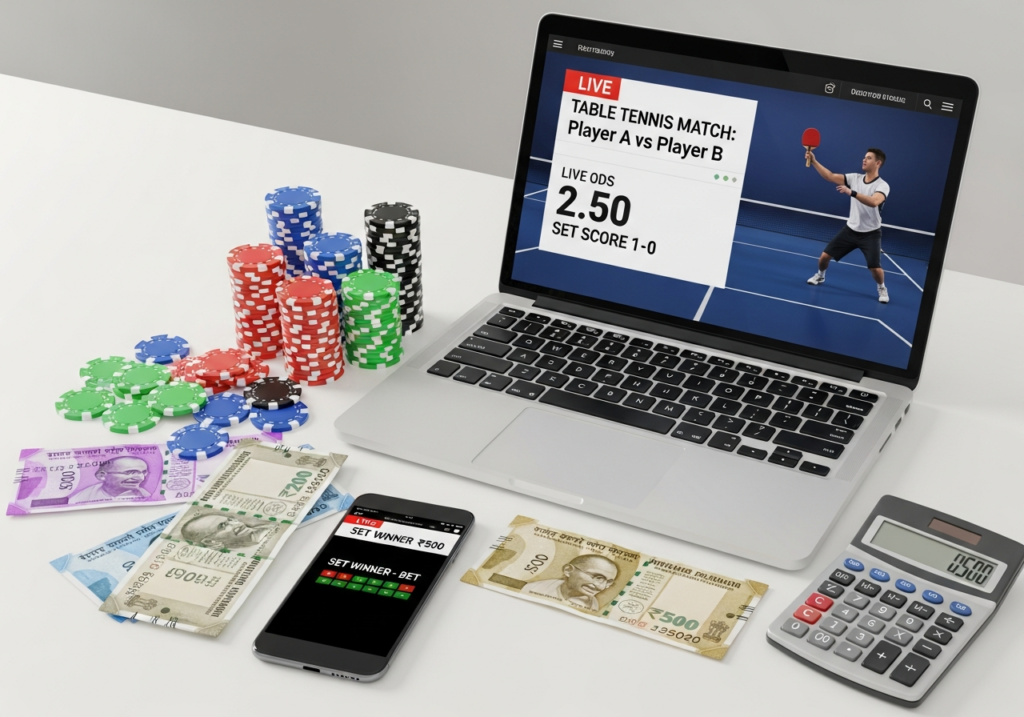
Table tennis betting has exploded in popularity globally over the past decade, and India is no exception. The sport’s fast pace, frequent tournaments, and dynamic live markets have made it increasingly attractive to Indian bettors seeking variety beyond traditional cricket and football betting. Whether you’re new to wagering or looking to expand your betting portfolio, understanding how to place bets on table tennis matches from India—and doing so responsibly—is essential. This guide walks you through the legal landscape, platform selection, bet types, practical strategy, and bankroll management tailored specifically to Indian bettors.
Understanding Table Tennis and the Betting Basics
Professional table tennis is structured in a way that creates consistent betting opportunities year-round. Matches typically consist of multiple sets, with each set played to 11 points, and a player must win by a margin of at least two points. Most professional competitions follow a best-of-five or best-of-seven set format, meaning a player needs to win three or four sets to claim victory. This scoring system creates natural breakpoints where odds shift and new betting markets open, especially during live play. The frequent matches on the professional calendar—WTT Series, regional tournaments, and domestic leagues—mean there’s almost always a match to bet on, making table tennis ideal for bettors who prefer high action and consistent market availability.
The speed and unpredictability of table tennis also explain why it attracts serious bettors. Momentum swings can happen within a single set, and a player trailing 0–2 in sets can still mount a comeback. This volatility, combined with accessible odds and a range of betting markets, creates opportunities for disciplined bettors to find value that casual bettors might miss.
How Table Tennis Matches Are Scored
In professional table tennis, each set is played to 11 points, and you must win by two points. If both players reach 10–10, play continues until one player opens a two-point lead (e.g., 12–10, 13–11). Most major competitions use a best-of-five format, where the first player to win three sets wins the match. Some tournaments, particularly men’s singles at certain events, may use best-of-seven (first to four sets).
This scoring structure directly impacts betting markets. Set winner bets are popular because sets are self-contained mini-matches within the overall competition. Total points markets (over/under) rely on understanding how many points a typical set might generate. In aggressive matches, sets finish faster; in defensive or defensive matchups, sets extend longer. Understanding this relationship helps bettors choose markets aligned with the playing styles of the competitors involved.
Key Betting Concepts You Must Know First
Before placing any bet, you need to understand the language of sports betting. Your stake is the amount of money you wager. Odds represent the probability of an outcome and determine how much you’ll win relative to your stake. In decimal odds (common in Europe and increasingly used by sportsbooks accepting Indian players), odds of 2.00 mean a ₹100 stake returns ₹200 (₹100 profit plus your original stake back).
A match winner bet (also called moneyline) is the simplest: you pick which player wins the match. A set winner bet focuses on a single set rather than the full match. Handicap bets give one player a virtual advantage or disadvantage (e.g., “Player A to win by 2+ sets”). Over/under bets predict whether the total number of points across all sets will exceed or fall short of a specified number. A parlay or accumulator combines multiple bets into one; all selections must win for the parlay to pay out, but the returns multiply accordingly.
Is It Legal to Bet on Table Tennis From India?
India’s gambling laws are complex and largely state-specific. The 1867 Public Gambling Act prohibits operating physical gambling venues but does not explicitly criminalize individuals placing bets with offshore operators. However, many states have additional local laws that regulate or restrict betting activities. Online betting via foreign-licensed sportsbooks sits in a gray area: while an Indian citizen placing a bet online with a licensed operator is technically in a legal gray zone, the operator itself is often unregulated in India.
Most Indian bettors use international sportsbooks licensed in jurisdictions like Malta, Curacao, or the UK. These platforms are legal in their home jurisdictions and accept Indian customers, though India’s Ministry of Information Technology has occasionally requested ISP-level blocks on certain domains. The practical reality is that many Indians continue to use these offshore platforms, often with the understanding that they’re accepting some regulatory uncertainty.
Importantly, this guide is informational and does not constitute legal advice. Before betting, you should research the current laws in your specific state and be aware that regulations may change. Responsible gambling practices—setting limits, never risking money you can’t afford to lose, and maintaining control—are far more important than the legal gray area itself.
Practical Considerations for Indian Bettors
When choosing an online sportsbook, prioritize platforms licensed by recognized authorities and those that implement robust Know Your Customer (KYC) verification. KYC requires you to provide identity proof, address verification, and sometimes bank details. This might feel intrusive, but it protects you: licensed platforms with KYC have financial safeguards and dispute resolution mechanisms that unregulated sites lack.
India’s tax authority may, in theory, require you to declare betting income. While enforcement on small recreational bettors is minimal, larger winnings could theoretically be flagged. Use platforms that provide clear bet history and statements for record-keeping. Most sportsbooks accept Indian payment methods including UPI, net banking, and e-wallets, making deposits and withdrawals straightforward. However, some banks may flag betting transactions, so be prepared for occasional payment delays or requests for additional verification.
Choosing Safe Sportsbooks and Platforms That Offer Table Tennis
Selecting the right sportsbook is foundational to a positive betting experience. Not all platforms offer equal table tennis coverage, and deposit/withdrawal reliability varies significantly. The table below outlines key features to compare when evaluating sportsbooks for table tennis betting:
| Sportsbook type (global/local) | Table tennis coverage | Licensing/jurisdiction | Payment options for Indians | Live betting quality | Key pros | Key cons |
|---|---|---|---|---|---|---|
| Established international (Malta/UK licensed) | Comprehensive (WTT, regional, domestic leagues) | Recognized authority (e.g., MGA, UKGC) | UPI, net banking, cards, e-wallets | Excellent (real-time odds, multiple markets) | Regulated, trustworthy, wide markets, competitive odds | May have payment delays, ISP blocking risk |
| Emerging international (Curacao licensed) | Good (major tournaments, fewer lower-tier events) | Curacao licensing authority | Limited Indian payment methods; often PayPal/crypto | Good but variable | Newer, sometimes faster payouts, niche markets | Less established reputation, less KYC rigor |
| Local Indian (where available) | Variable, often cricket-focused | Varies; often unregulated | Optimized for Indian payments | Varies widely | Local support, no blocking concerns | Often weak table tennis offering, higher risk, unclear KYC |
What to Look For in a Table Tennis Sportsbook
When evaluating any platform, use this checklist to identify safe, reliable operators:
- Licensing: Verify the sportsbook’s license from a recognized gambling authority (Malta Gaming Authority, UK Gambling Commission, Curacao, etc.). Avoid unlicensed platforms entirely.
- Table tennis event coverage: Check the range of competitions offered. Top-tier platforms cover WTT Series events, national leagues, and regional tournaments; entry-level sites may offer only major tournaments.
- Live streaming or live tracking: Real-time match updates help you make informed in-play bets. Ensure the platform offers this for table tennis matches you plan to bet on.
- Odds competitiveness: Compare odds for the same match across 2–3 platforms. Stronger sportsbooks offer tighter (more competitive) odds, meaning better value for you.
- Indian payment methods: Confirm UPI, net banking, or e-wallet deposits are available and fast. Avoid platforms requiring only crypto or international wire transfers.
- Bet limits and restrictions: Check maximum payout limits and any restrictions on certain markets. Some platforms cap live betting stakes or total payouts.
- Clarity of rules: The platform should clearly state match cancellation policies, voiding rules, and how live bets are settled if play is suspended.
Deposits, Withdrawals, and KYC for Indian Users
Most sportsbooks accepting Indian customers require a standard KYC process: you’ll provide a government-issued ID, address proof (utility bill, bank statement), and sometimes a selfie for verification. This typically takes 24–48 hours. Once verified, you can deposit via your preferred Indian payment method.
UPI (Unified Payments Interface) is now the fastest option on most platforms; deposits settle within minutes. Net banking offers similar speed and security. Credit/debit cards work but may occasionally be blocked by your card issuer if flagged as a gambling transaction. E-wallets like Skrill or PayPal are available on some platforms. Withdrawal times vary: UPI typically returns funds within 24 hours, while net banking may take 2–5 business days. Set daily or weekly deposit limits through the platform’s responsible gambling tools—most sportsbooks allow you to configure these before you start betting.
Main Types of Table Tennis Bets Explained
Understanding the different markets available is crucial for building a flexible betting strategy. Different matches and situations call for different bet types. Below is a structured overview of the most common table tennis bets you’ll encounter:
| Bet type | What it means | Typical use case | Risk level | Example in a real match |
|---|---|---|---|---|
| Match winner (moneyline) | Pick which player wins the match | Favorite/underdog distinction clear; simple prediction | Low | Betting on top seed to defeat qualifier; odds 1.50 |
| Set winner | Predict the winner of a specific set | Match is close; you’re confident about one set but uncertain about the full match | Medium | Betting on Player A to win the second set; odds 1.80 |
| Handicap (-2 sets / +1 set) | Give one player a virtual advantage/disadvantage in sets | One player is heavily favored; you want to adjust odds for balance | Medium-High | Betting on clear favorite to win by 2+ sets; odds 2.10 |
| Total points over/under | Predict whether total points across all sets exceed or fall short of a number (e.g., 110.5) | Playing styles are predictable (e.g., two defensive players = longer sets) | Medium | Betting over 115 points; odds 1.90 |
| Correct score | Predict the exact final set count (e.g., 3–1 or 3–0) | You’re very confident in the outcome and want high odds | High | Betting 3–0 in a lopsided match; odds 4.50 |
| Parlay/accumulator | Combine multiple bets; all must win for payout | Confident in multiple matches; seeking higher returns with reduced stake | High | Two match winner bets × two set winner bets combined; odds 8.00 |
Advanced Markets: Player Totals and Correct Scores
Beyond standard markets, sophisticated sportsbooks offer more granular options. Player total points bets predict how many points a specific player will score in a match or set. If Player A scores between 33–39 points in a best-of-five match, that’s one outcome; 40+ points is another. These bets require familiarity with typical scoring patterns for that player and opponent.
Set-specific totals narrow the focus further: you bet on total points in just the first set or a nominated set. Exact match scores or correct score markets are the highest variance bets. Betting 3–2 in a best-of-five is easier than betting 3–0 (a sweep), so odds scale accordingly. These markets offer appealing odds—3–0 might be 4.50+—but the outcome must be precise, making them riskier. Beginners should avoid these initially; once you’re familiar with player tendencies, they can be valuable for very specific situations.
Live Table Tennis Betting and In‑Play Strategy for Indians
Live betting is where table tennis truly shines for wagering. Because matches unfold over hours (even single matches can last 90+ minutes), odds shift dramatically as play progresses. A player down 0–2 in sets might see their odds lengthen significantly, but if they win the third set, those odds contract. This creates fleeting opportunities for value bets that pre-match odds didn’t offer. However, live betting also moves fast and can be emotionally charged. Here’s a structured approach to live betting on table tennis:
- Watch the match before betting. Don’t place live bets based on scorelines alone. Observe the quality of play, momentum, and which player appears more composed. A player up 2–0 but struggling might be more vulnerable than their set count suggests.
- Set a live betting limit before the match starts. Decide how much you’re willing to stake on in-play bets for that match (e.g., ₹500 across all live bets). Once you hit that limit, stop. This prevents emotional escalation during the match.
- Identify one or two strong opportunities per match. Rather than betting after every point swing, wait for high-conviction moments: after a set win/loss when odds overreact, or when a player’s playing style clearly dominates the opponent’s. A poorly timed bet after one set is often worse than no bet at all.
- Track the odds trajectory. Note the odds when you enter the match and observe how they shift. If odds on an underdog drop from 4.50 to 2.50 after one set, the market has reassessed. This tells you something meaningful about the match dynamics.
- Avoid chasing losses with progressive stakes. If you lose a live bet, don’t immediately place a larger bet to “recover.” Stick to your unit size. This is the most dangerous trap in live betting.
- Use pre-match research during live play. If you analyzed player form and head-to-head records before the match, reference those notes as you watch. A player with a poor head-to-head record who’s suddenly ahead might be overperforming; backing the other player at longer odds could be smart.
Common Live Betting Mistakes to Avoid
- Over-betting on volatile point-level markets. Betting on the winner of individual points or short rallies is extremely high-variance. Avoid these; focus on set and match outcomes.
- Ignoring pre-match odds as a reference. If pre-match odds had one player at 2.00 and they’re now 1.50 after one set, that reflects rational market adjustment—not necessarily a bet you should take.
- Emotional chasing after losses. Losing a set winner bet and immediately betting the next set at 50% of your bankroll is a path to ruin. Pause, breathe, and reassess.
- Treating every match equally. A live bet on a WTT Series match (high-level players, tight outcomes) is not the same as a lower-tier domestic league match. Quality of competition affects volatility and predictability.
- Betting with sound off or on mute. You need to watch the match, not just glance at odds. Many bettors make impulsive decisions without actually observing play quality.
Using Pre‑Match Odds and Statistics During Live Play
Pre-match odds distill expert consensus about the matchup. If Player A opened at 1.80 and Player B at 2.00 before the match, that means bettors and oddsmakers expected a close contest. Now suppose Player A loses the first set. Their odds might drop to 1.60, while Player B jumps to 2.50. This doesn’t mean Player B will definitely win; it means the market thinks the loss indicates Player A is less likely to win overall. However, if you studied Player A’s head-to-head record and noticed they often lose the first set to defensive players but then adjust and win the next three, the longer odds on Player A might represent genuine value.
Similarly, pre-match stats show player averages: average points per set, set win percentage, first-set performance. If Player A typically averages 24 points per set but scores only 18 in the first set, they may have been off form or the opponent was exceptional. By set two, they might normalize. Comparing live observations against pre-match data helps you distinguish between a player hitting form and a player genuinely outmatched.
Building a Basic Table Tennis Betting Strategy
Successful table tennis betting isn’t about guessing outcomes; it’s about finding situations where your analysis reveals value that the market has mispriced. A basic strategy consists of three elements: selecting specific tournaments and levels, researching player form and style, and disciplined staking. Rather than betting on every match, focus on 3–5 leagues or tournament series where you feel confident evaluating players.
Start by choosing a tier: professional WTT Series (highest level, most consistent), national league systems, or regional qualifiers. Learn the typical strength differences between tiers. Once you’ve chosen your focus, study the players regularly. Build a simple spreadsheet tracking recent results, head-to-head records, and playing styles. Over time, you’ll recognize patterns (e.g., Player X struggles against aggressive hitters but beats defensive players). When those matchups occur, and the odds don’t reflect your analysis, you’ve found a betting opportunity.
Avoid the temptation to bet on matches where you lack conviction. A “no bet” decision is often your best decision. Skilled bettors pass on far more matches than they bet on, waiting for situations where they genuinely believe the odds are out of line.
Evaluating Players: Form, Style, and Motivation
Thorough player evaluation is the cornerstone of a winning strategy. Don’t rely on intuition or a player’s reputation; use data and observation:
- Recent win/loss record (last 10–20 matches): A player’s overall ranking can mask poor recent form. If a top-20 player has won only 2 of their last 8 matches, they’re underperforming. Check the quality of opponents they faced, too. Losses to top-5 players mean less than losses to unranked players.
- Performance against similar opponents: Some players excel against defensive players but struggle against aggressive attackers. Cross-check your player’s record against players with similar styles to today’s opponent.
- Playing style (attacking vs. defensive, pace preference): Does Player A thrive in quick rallies or long exchanges? Does Player B struggle returning fast loops? Stylistic matchups matter. A conservative player can neutralize an aggressive style; mismatch analysis often reveals value.
- Scheduling and fatigue: A player who’s played three matches in the last two days is more fatigued than an opponent with two days’ rest. Check the tournament schedule. In WTT Series events, group play can be grueling; note fatigue as a tiebreaker.
- Motivation and stakes: In a tournament’s early rounds, seeded players sometimes rest or aren’t fully engaged. In finals, motivation is maximum. Be aware of which round you’re betting on and each player’s perceived stake in the match.
- Injury and form notes: Before major events, sportsbooks and betting forums often discuss injuries. A player returning from a break may lack match rhythm. Factoring these in helps you avoid traps.
Bankroll Management and Risk Control for Indian Bettors
Even the best analysis yields losing streaks. Bankroll management—the system you use to size bets relative to your total betting capital—determines whether a losing streak bankrupts you or is merely a setback. Below, compare common staking approaches and their suitability for table tennis:
| Staking approach | Description | Pros | Cons | Suitability for table tennis | Suitability for beginners |
|---|---|---|---|---|---|
| Flat betting | Bet the same amount (₹100, ₹500, ₹1000) on every bet | Simple, transparent, protects bankroll | Larger bets may feel too small relative to bankroll | Excellent; table tennis’s high match frequency benefits consistency | Excellent; removes pressure to vary stakes |
| Unit-based (1–5% of bankroll per bet) | Size each bet as a percentage of your total bankroll (e.g., 2% = 1 unit) | Adapts to bankroll growth/shrinkage automatically; professional approach | Requires frequent recalculation; harder for beginners | Very good; bankroll shrinkage from losses auto-adjusts stake size | Good if explained clearly |
| Kelly Criterion (advanced) | Mathematical formula sizing bets based on odds and perceived edge | Theoretically optimal for long-term growth | Complex, requires accurate probability estimates; risks large swings | Fair; requires deep match analysis | Poor; too complex for beginners |
| Martingale or progressive systems (doubling after losses) | Increase bet size after each loss to recover losses | Tempting promise of guaranteed profits | Catastrophic risk; losing streaks wipe out bankroll; prohibited by most sportsbooks | Poor; table tennis’s speed makes this extremely dangerous | Very poor; actively discouraged |
For most Indian bettors, flat betting or a simple unit-based approach works best. If your total betting bankroll is ₹10,000, flat betting might be ₹100 per bet (1% of bankroll). If you have ₹50,000, you might use ₹500 per bet. As your bankroll grows, so do your stakes; if it shrinks, stakes shrink too, protecting you from ruin.
Table tennis’s high match frequency (matches happen almost every day) makes disciplined staking essential. The temptation to bet on “just one more match” to recover a loss is enormous. A strict bankroll system removes emotion from stake sizing.
Setting Personal Limits and Staying in Control
Beyond math, control is behavioral. Use the tools most sportsbooks provide:
- Daily deposit limit: Set a maximum you’re willing to deposit in a day (e.g., ₹2000). Once you hit it, you can’t deposit more that day, even if you want to chase a loss.
- Weekly or monthly loss limit: Decide the maximum you’ll lose in a week (e.g., ₹5000). If you hit it, take a break.
- Stake limit: Some platforms let you cap the maximum stake on a single bet, preventing impulsive large wagers.
- Self-exclusion: If you feel control slipping, use the self-exclusion feature to lock your account for a set period (days, weeks, or months). This is a nuclear option but prevents further betting during crisis moments.
- Separate betting funds: Never use money earmarked for rent, groceries, or savings. Treat betting as entertainment with a fixed budget, like movies or dining out.
Recognizing Problem Gambling Early
Problem gambling develops gradually. Warning signs include: regularly chasing losses (betting larger amounts to recover), hiding betting from family or friends, using credit or loans to fund betting, abandoning hobbies to focus on betting, and experiencing anxiety when unable to bet. If you notice these patterns, pause immediately. Organizations like the National Council for Responsible Gambling (India) and international bodies like Gamblers Anonymous offer free support.
Practical Examples and Sample Betting Scenarios
Theory becomes actionable through examples. Below are realistic scenarios an Indian bettor might face and how to approach them:
| Scenario | Market chosen | Reasoning | Risk level | Possible outcomes | Key lesson |
|---|---|---|---|---|---|
| World #5 vs. world #50 in round 1 of a WTT Series event; odds 1.30 for #5. | Match winner (Player #5) | Clear favorite with strong form. Odds suggest market agreement. However, 1.30 returns are low. Bet ₹500 at 1.30 = ₹150 profit. | Low | #5 wins (profit ₹150); #50 upset (loss ₹500). Expected value slightly positive given odds and form. | Favorites are favorites for a reason. Don’t avoid them; just size bets modestly since returns are capped. |
| Player A (attacking) favored at 1.90 vs. Player B (defensive) at 1.85 in a domestic league match. Your analysis: A struggles against defensive players historically (52% loss rate), but odds don’t reflect this. | Match winner (Player B) | Odds are mispriced. B’s style matches your analysis. Longer odds compensate for the underdog position. | Medium | B wins (profit ₹425 on ₹500); A wins (loss ₹500). If your analysis is correct, this is +EV over the long term. | Sometimes the underdog is underpriced. Trusting your analysis against general opinion is profitable if systematic. |
| Best-of-five match between two attackers; expected scoring pace is fast. Under 120 total points is 1.95; over is 1.85. Your analysis: both players’ recent matches averaged 130 points. | Total points over 120 | Market has underestimated pace. Your data suggests over is more likely. | Medium | Over wins (profit ₹425); under wins (loss ₹500). Consistent with trend data. | Volume/speed markets are often soft. Tracking player-specific averages reveals mispricings. |
| Player A (ranked #10) is down 1–0 in sets with live odds at 2.50. You watched set 1: A played poorly. Pre-match odds had A at 1.75. Your analysis: A is capable; odds overreacted. | Match winner on Player A (live bet) | Pre-match analysis + live observation suggest A is still favored long-term. Odds of 2.50 are generous. Bet ₹200. | Medium-High | A wins overall (profit ₹300); A loses (loss ₹200). Expected value positive if A’s true probability of winning is >40%. | Live betting can offer value when pre-match analysis intersects with in-play observation. Don’t chase; bet selectively. |
| Local qualifier vs. international player at a regional tournament. You have no data on the qualifier. Match is close odds at 1.95/1.85. | Pass / no bet | Without reliable data on the qualifier, you have no edge. Betting random matches erodes bankroll long-term. | N/A (no bet) | Irrelevant | Discipline includes passing bets where you lack an information advantage. This is often the best decision. |
From Theory to Practice: Creating Your First Betting Plan
Now that you’ve absorbed frameworks and examples, here’s a step-by-step plan to start betting responsibly:
- Choose your focus: Pick one table tennis competition or tier (e.g., WTT Series, or a specific national league). Limit yourself to 3–5 events per week initially.
- Research players: Spend 1–2 weeks watching matches and building a simple spreadsheet: recent record, head-to-head stats, playing style, form trajectory.
- Identify high-conviction matchups: After research, mark 1–2 matchups per week where you genuinely believe the odds are mispriced. Don’t bet on every match.
- Set your bankroll and unit size: If you have ₹10,000 available for betting, use ₹100 per bet (1%). If ₹50,000, use ₹500 per bet. Do not deviate.
- Select your bet: For your first bets, stick to match winner. As you gain experience, add set winners and totals.
- Place the bet and document: Record the match, your reasoning, the bet type, odds, stake, and result in a spreadsheet. This is your learning record.
- Review outcomes monthly: After 30–50 bets, analyze results. Which matchup types did you win? Lose? What patterns emerge? Adjust your research focus accordingly.
- Add new markets and edge gradually: Once you’re consistent with match winners, explore set winners or handicaps in specific situations where you’ve found an edge.
The first 3 months are your learning period. Expect mixed results. Your goal is not to get rich but to build a sustainable, analytical approach and ensure no single losing streak destabilizes your finances or well-being. Patience and discipline, far more than luck, determine long-term success in table tennis betting from India.