
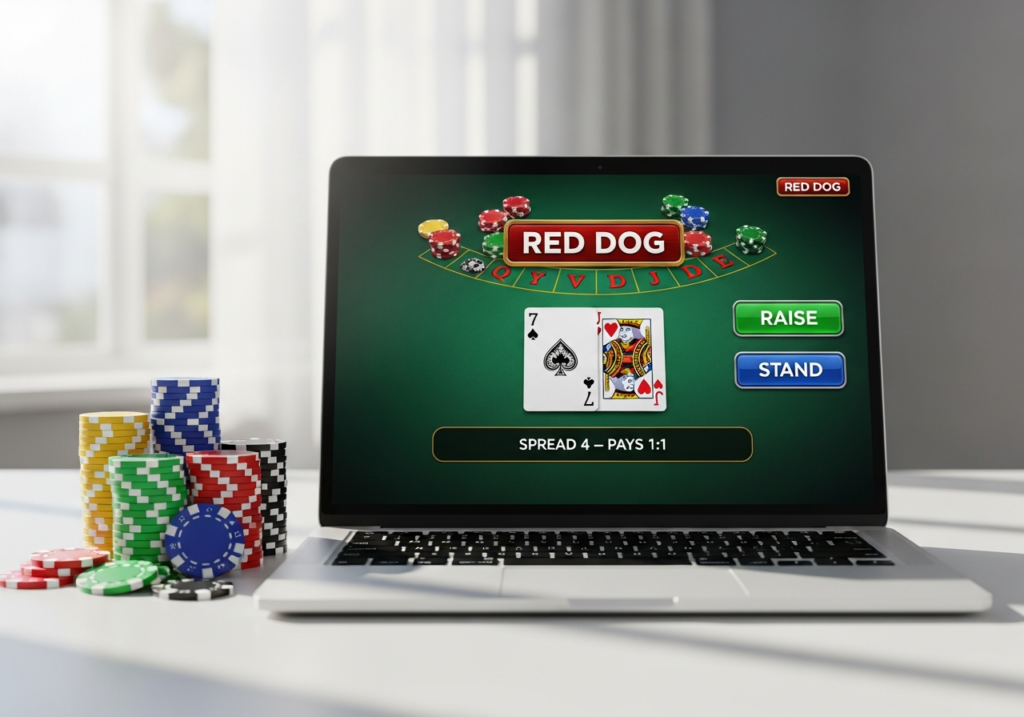
Red Dog is one of the simpler card games you’ll encounter in online casinos, yet its straightforward nature often masks important nuances that can affect your enjoyment and success. If you’re an Indian player exploring online tribal casinos or India-facing international gambling platforms, understanding the precise rules of Red Dog will help you play confidently and make informed betting decisions. This guide walks you through the complete ruleset, payouts, strategy considerations, and practical tips tailored to the real-money online Red Dog experience—without offering legal advice on the regulatory landscape.
What Is Red Dog and Where You’ll Find It in Indian Casinos
Red Dog is a casino banking game in which the house acts as the dealer and you bet on the outcome of three dealt cards. The core premise is elegantly simple: two cards are dealt face-up, and you wager whether a third card will fall in rank between those two cards. Card suits are irrelevant; only rank matters. Aces are valued as high (above kings), and cards rank from 2 (low) to Ace (high). The game’s low barrier to entry—combined with relatively fast rounds and flexible betting—makes it popular in both traditional and online casino environments.
Red Dog in Land-Based and Tribal Casino Context
Red Dog has maintained a presence in land-based casinos and some U.S. tribal gaming venues for decades, typically occupying a spot among the classic table games. In tribal casino settings, Red Dog is sometimes offered alongside poker variants and other Class III casino games, where it appeals to players seeking something simpler than blackjack but more engaging than pure slot machines. For Indian players based in India, direct access to tribal casinos is limited, so the real Red Dog experience for most comes via offshore, internationally licensed online casinos that accept Indian players. These platforms offer Red Dog in both RNG-powered and, occasionally, live dealer formats.
Online Red Dog for Indian Players
When you play Red Dog online at India-facing casinos, you’re typically engaging with a Random Number Generator (RNG)-based version. The dealing simulation and card sequencing are controlled by certified algorithms that mimic the statistical distribution of a shuffled deck. This differs from social/play-money casino apps, which focus on entertainment rather than real-money outcomes. Throughout this guide, we focus on real-money online Red Dog as played at licensed international casinos—the version where rules, payouts, and fairness matter most to your bankroll.
Card Values, Decks and Basic Terminology in Red Dog
| Element | Rule in Red Dog | Notes for Online Play |
|---|---|---|
| Card Ranking | 2 (low) to Ace (high); suits irrelevant | Online displays typically highlight card rank prominently for clarity |
| Spread | The number of card ranks between the two initial cards | Spread directly determines payout; online software usually calculates and displays it instantly |
| Push | Outcome when the third card equals one of the first two or is consecutive to both | In most online casinos, push returns both ante and raise bets unchanged |
| Ante Bet | Mandatory opening bet to enter a round | Fixed stake set by the player; required before any cards are dealt |
| Raise Bet | Optional additional bet placed after seeing the spread | Only available if the spread allows a third card to be dealt |
| Three of a Kind | When all three dealt cards have the same rank | Typically pays 11:1 in standard online Red Dog implementations |
| Pair | Two cards of the same rank | May yield a push or three-of-a-kind payout depending on the third card |
| Consecutive Cards | Two cards whose ranks are adjacent (e.g., 5 and 6) | Often results in an automatic push in standard rules |
Understanding the Spread, Push and Three of a Kind
The spread is the backbone of Red Dog strategy and payouts. Once the first two cards are dealt, you instantly know how many distinct ranks exist between them. For example, if you see a 4 and a 9, the spread is 4 (the ranks 5, 6, 7, and 8 fall between them). A wider spread means more ranks the third card could land in to beat you—which reduces your win probability but increases your payout. Conversely, a narrow spread (say, 2 ranks between cards) gives the third card fewer options to land in between, so your odds of winning improve, but the payout is typically smaller.
A push occurs when the third card matches the rank of one of the first two cards or, in some rulesets, when the cards are consecutive with no ranks between them. In either case, your ante and any raise bet are returned without profit or loss. Three of a kind—all three cards having identical rank—is the rarest outcome and is rewarded with an 11:1 payout in most standard online casinos, making it an attractive wild-card possibility that keeps the game exciting.
Step-by-Step: How a Round of Online Red Dog Works
- Place Your Ante Bet — Before any cards are dealt, you select your stake size (respecting the table minimum and maximum) and confirm your ante bet. This locks in your participation for the round.
- First Two Cards Are Dealt — The online software instantly displays two cards face-up. The software simultaneously calculates and displays the spread (the number of ranks between the two cards).
- Identify Special Cases — The game immediately checks for consecutive cards or pairs. If the two cards are consecutive (e.g., 7 and 8), a push is declared and your ante is returned. If they are a pair, the game proceeds to deal a third card immediately.
- View the Spread and Payout — For non-consecutive, non-pair hands, the online interface displays the spread size and the corresponding payout odds if you win (for example, “Spread 6 — Pays 2:1”).
- Decide to Raise or Stand — You now choose whether to place an optional raise bet (equal to or greater than your ante, depending on the casino’s rules) or simply stand and let the third card be dealt with only your ante at risk. The raise button or equivalent option appears on your screen.
- Third Card Is Dealt — Regardless of your raise decision, the third card is now revealed.
- Settle the Round — The software instantly evaluates whether the third card’s rank falls between the first two. If it does, you win your ante and your raise (if placed) at the payout odds. If it doesn’t, you lose your antes and raises. If it’s a push (equals one of the first two or consecutive), stakes are returned.
- Balance Updates — Your account balance is immediately credited or debited, and the round result is logged. You can now place a new ante for the next round.
Special Outcomes: Consecutive Cards and Pairs
Consecutive cards—such as a King and Queen, or a 5 and 6—trigger an automatic push because there are zero ranks between them. Some online implementations clarify this on the screen before you’re offered the raise option. Paired cards (e.g., two 9s) proceed to a third card deal; if the third card matches the pair rank, you win 11:1; otherwise, the outcome depends on whether the third card is between (impossible with a pair) or equal/out of range, resulting in a push.
How Online Software Automates the Round
Online Red Dog’s primary advantage over live dealer versions is speed and clarity. The software instantly calculates spread, displays the payout odds, offers raise/stand buttons, and settles the round in seconds. You don’t wait for a dealer’s physical actions or see ambiguous card positions. Instead, clear numerical spreads and payout multipliers are displayed, reducing confusion. The balance updates automatically, and animations (if enabled) provide visual feedback without slowing gameplay.
Bet Types in Red Dog: Ante, Raise and Table Limits
| Bet Type | When You Place It | Risk/Reward Characteristics |
|---|---|---|
| Ante | Before the first two cards are dealt | Mandatory entry stake; defines your unit size for the round; risked on every hand |
| Raise | After the spread is revealed and before the third card is dealt | Optional; made only if you approve of the spread; pays out at the odds shown for that spread |
| Table Minimum | Lowest allowed ante at that table | Typically ₹10–₹50 at Indian-facing sites; constrains the smallest unit you can bet |
| Table Maximum | Highest allowed ante at that table | Typically ₹1,000–₹10,000 depending on the casino tier; limits your largest single bet |
Managing Stakes and Table Limits Online
- Start with table minimums until you understand the rhythm of the game and feel comfortable with your bankroll allocation.
- Understand that the raise bet is optional but often mathematically sensible; only raise when the spread is wide enough to justify the added risk.
- Avoid over-raising on narrow spreads (1–2 ranks) even if you feel lucky; the odds don’t favour large bets.
- Be aware of currency conversion fees or payment-method margins if you’re depositing in INR; these can erode small staking edges.
- Many Indian-facing casinos offer session-limit tools; use them to cap your total spend per day.
Red Dog Payouts by Spread Size
| Spread Size (Ranks Between Cards) | Standard Payout | Example Card Combination |
|---|---|---|
| 0 (Consecutive) | Push (no win/loss) | 5–6, 10–J, K–A |
| 1 | 5:1 | 3–5, 7–9, J–K |
| 2 | 4:1 | 2–5, 6–9, 9–Q |
| 3 | 2:1 | 2–6, 5–9, 7–J |
| 4 | 1:1 | 2–7, 4–9, 6–J |
| 5+ | 1:1 | 3–9, 4–J, 2–10 |
| Pair (e.g., 7–7) | 11:1 if third card matches; Push otherwise | Any two identical ranks |
| Three of a Kind | 11:1 | 7–7–7, K–K–K |
Three of a Kind and Push Outcomes
Three of a kind is the premium outcome. Whenever all three cards share the same rank, you receive a payout of 11:1 on your ante (and your raise, if placed). This is independent of the spread and applies whether you’re holding a pair and the third card matches, or whether the initial two cards are a pair and the third happens to match as well. Push outcomes—triggered by consecutive cards or a third card matching one of the first two—return your ante and raise bets without profit or loss. No money is won or lost; it’s a reset.
Variations in Online Casino Payout Tables
While the payout schedule above represents the standard used by most reputable online casinos, some operators may adjust payouts slightly, which can change your long-term return (RTP). Before playing real money, always open the in-game paytable or rules screen (usually accessible via a “?” icon or “Help” menu) and confirm the exact payouts for each spread size. Some casinos might offer 6:1 instead of 5:1 for a 1-rank spread, or vice versa. These variations compound over many rounds, so verify first.
House Edge, RTP and Odds in Red Dog
The house edge in Red Dog is the mathematical advantage the casino maintains over time. This edge arises from the payout structure: while spread payouts are calibrated to be close to fair, the push outcomes on consecutive cards and matched third cards slightly favour the house. A typical Red Dog payout table results in an RTP (Return to Player) of around 97–98%, meaning that over a very large number of hands, you’d expect to lose approximately 2–3% of your total wagered amount. This is competitive with many other casino games.
Several factors influence Red Dog’s house edge for any given casino. The most critical is the paytable itself: wider payouts on narrow spreads reduce the house edge, while tighter payouts increase it. The number of decks in use (if disclosed) can slightly affect probability. Online RNG dealing models may differ from single-deck or multi-deck shoe assumptions, though modern algorithms aim to neutralize this. Finally, the exact push rules and how the raise is settled all play a role. Always compare disclosed RTPs or derive expectations from the paytable before committing funds.
What Influences Red Dog’s House Edge
- Paytable structure — Casinos with higher payouts for narrow spreads offer better player value and lower house edge.
- Push mechanics — Strict definitions of when a push occurs directly impact win/loss frequency.
- Raise rules — Whether the raise pays at the same odds as the ante, or at different odds, changes expected value for raising decisions.
- Deck simulation — If the casino discloses deck count or dealing model, verify it matches the probability assumptions you’re using for strategy.
Basic Red Dog Strategy for Indian Online Casino Players
- Always raise on spreads of 5 or more ranks — The payout odds (typically 1:1 or better) align with or exceed your probability of winning, making the raise mathematically sound.
- Raise cautiously on spreads of 3–4 ranks — Payouts of 2:1 to 1:1 are near the break-even point; raise if you’re in a good mood and accept variance, or stand if you prefer lower variance.
- Avoid raising on spreads of 1–2 ranks — Payouts of 5:1 or 4:1 may look attractive, but the narrow spread means few cards can land between, making wins rare; the house edge on these raises is significant.
- Never chase losses by raising larger sums — Emotional betting is the fastest way to drain a bankroll; stick to your predetermined ante size and raise only when spread odds justify it.
- Recognize three-of-a-kind as a bonus, not a strategy — The 11:1 payout is exciting, but it’s so rare (approximately 1 in 221 hands) that you shouldn’t factor it into your decision to raise or stand on ordinary spreads.
When to Raise and When to Stand
The decision to raise hinges on comparing the spread payout to the probability that the third card will land between your two initial cards. With a spread of 6 ranks (say, a 2 and a 9), the payout is typically 1:1. Your probability of the third card landing in ranks 3–8 is 6 out of 13 possible ranks (excluding the two cards already dealt), or roughly 46%. A 1:1 payout on a 46% probability outcome is roughly break-even, so raising is reasonable if you’re comfortable with variance. With a spread of 1 (e.g., a 5 and a 7), the payout might be 5:1, but your win probability is only 1 out of 11 remaining cards, or about 9%. That 5:1 payout on a 9% probability is attractive in expectation, but the low hit rate means you’ll experience long cold streaks; raise only if your bankroll can weather them.
Bankroll Management Tailored to Red Dog
- Set a session loss limit before you begin — Decide in advance the maximum amount you’re willing to lose in a single session (e.g., ₹500). Once you’ve lost that amount, stop playing and walk away.
- Choose an ante size as 1–2% of your total session budget — If your session budget is ₹500, bet ₹5–₹10 per hand. This preserves your bankroll and allows you to stay in the game longer, reducing the impact of short-term variance.
- Limit your raises to 2–3 hands per session — Raising is optional and exciting, but frequent raising escalates your risk quickly. Decide in advance how many raise bets you’ll permit yourself, and stop when you’ve hit that limit.
- Plan for short sessions — Red Dog rounds are fast. Playing for just 20–30 minutes with disciplined ante and raise sizing is more sustainable than marathon sessions that tempt emotional decisions.
Online Red Dog Rules vs Traditional Variants
| Red Dog Variant | Key Rule Differences | Relevance for Indian Online Players |
|---|---|---|
| Casino Red Dog (Standard) | Fixed paytable by spread; optional raise; push on consecutive or matched third card | This is the version at nearly all online casinos; rules below apply to this |
| Home-Game Red Dog | Highly variable; often played with wild cards or house rules; no standardized payout | Not relevant to online play; casinos do not use home-game rules |
| Heads-Up Red Dog | One player vs. dealer in a heads-up format; sometimes with side bets | Rare online; most online casinos use the standard banking version |
| Progressive Jackpot Red Dog | Standard base game with optional side bet for a progressive prize | Some online casinos offer a three-of-a-kind progressive; check paytable |
Why Online Casinos Prefer the Casino Red Dog Variant
Online casinos standardize on casino-style Red Dog because its rules are transparent, its paytable is easily communicated, and its settlement logic is unambiguous for RNG algorithms. The optional raise mechanic gives players agency, which increases engagement, while the fixed payout structure ensures the casino’s house edge is predictable and reproducible. This consistency allows casinos to confidently offer the game alongside audits and RTP disclosures, building player trust.
Understanding RNG, Fairness and Game Rules Screens
Every online Red Dog game uses a Random Number Generator to determine the sequence of cards dealt. The RNG is seeded with a cryptographic value and produces a stream of random numbers that are mapped to card ranks. Reputable online casinos test their RNGs against industry standards (e.g., those set by eCOGRA, iTech Labs, or similar auditors) to verify that the distribution of dealt hands matches theoretical expectations. This testing is distinct from game logic verification—that is, ensuring the software correctly calculates spreads and payouts—but both are essential to fair play.
Reading the In-Game Rules and Paytable
When you launch Red Dog at an online casino, look for an information icon (often a “?” or “i”) that opens the rules and paytable screen. This screen should clearly show:
- The payout for each spread size (0, 1, 2, 3, 4, 5+).
- The three-of-a-kind payout (typically 11:1).
- The push conditions (consecutive, or third card matching one of the first two).
- The minimum and maximum ante and raise bets.
- Any special rules or exceptions.
Take 30 seconds to review this before playing real money. If the paytable is unclear or missing, contact the casino’s support team or consider playing elsewhere.
Fair Play Indicators at Indian-Facing Online Casinos
Look for casinos that prominently display:
- Licensing information — A licence number from a recognized jurisdiction (e.g., Malta, Curaçao, Isle of Man) on the footer or “About” page.
- RTP or house-edge disclosure — A clear statement of the game’s RTP or house edge for Red Dog specifically.
- Third-party audit reports — Some casinos publish reports from auditors confirming RNG fairness and payout accuracy.
- Responsible gambling tools — Access to self-exclusion, deposit limits, and loss limits directly from your account settings.
These indicators don’t guarantee fairness, but they signal a casino’s commitment to transparency and accountability. Prefer sites with these signals over those that hide their terms.
Legal and Practical Considerations for Indian Players
The legal status of online gambling for Indian residents is complex and varies by state. Some states tolerate offshore gambling, while others have stricter interpretations of law. This guide is for informational purposes and does not constitute legal advice. Before playing real-money Red Dog online, verify the current regulations in your jurisdiction. Many Indian-facing online casinos require players to be at least 18 years old and to verify their identity (KYC — Know Your Customer compliance). These are standard safeguards and should not deter you from reputable sites; in fact, they are signs of legitimacy. If you reside in India and choose to play at an international casino, understand that regulatory protections may be limited compared to domestic gaming.
Responsible Gambling When Playing Red Dog Online
- Set time limits — Decide in advance how long you’ll play (e.g., 30 minutes) and stick to it; use any built-in timer provided by the casino.
- Never play when stressed or emotional — Red Dog is entertainment, not a way to recover losses or solve financial problems; play only when calm and rational.
- Use self-exclusion if available — Most reputable casinos offer self-exclusion tools that temporarily or permanently bar you from your account; use these if you feel you’re losing control.
- Track your spending — Keep a simple log of your deposits, losses, and wins. Review it weekly to ensure you’re within your entertainment budget.
- Avoid chasing losses — If you’ve hit your session loss limit, stop immediately. The urge to “win it back” is the most dangerous impulse in gambling.
- Seek help if needed — Organizations like the National Council for Problem Gambling (in the U.S.) and similar bodies in India offer confidential support; don’t hesitate to reach out.
Common Mistakes and Misunderstandings in Red Dog
- Misinterpreting the spread — The spread is the count of ranks between the two cards, not including the cards themselves. A King (13) and a 4 gives a spread of 8 (ranks 5–12); don’t accidentally count the King and 4 as part of the spread.
- Assuming consecutive or paired cards always lose — Consecutive cards result in a push, not a loss; you get your money back. Paired cards trigger a third card, which could result in three of a kind (11:1 win) or a push; they are not automatic losses.
- Raising on low-spread hands with small payouts — A 1-rank spread paying 5:1 might seem tempting, but your probability of winning is only 1 in 11 remaining cards (~9%). The long stretches between wins make this a poor bet for most players.
- Mixing home-game rules with casino rules — If you’ve played Red Dog at home or with friends, the rules might differ (e.g., wild cards, different payout structures). Always confirm you’re playing by the casino’s rules before wagering real money.
- Assuming all online casinos have the same payout table — Different casinos may adjust payouts. Always check the in-game paytable before playing a new site.
How to Quickly Check You’re Playing by the Right Rules
Before your first real-money hand at a new casino, run through this checklist:
- Card ranking confirmed — Verify that Ace is high and 2 is low.
- Spread and payout table confirmed — Check that the payout for your favourite spread size matches what you expect.
- Push conditions confirmed — Verify that consecutive cards and matched third cards trigger a push (not a loss).
- Ante and raise mechanics confirmed — Understand when you can raise, what size raise is allowed, and whether your raise bet pays at the same odds as your ante.
Taking 60 seconds to confirm these four points will prevent frustration and rule disputes later.
Red Dog is a game of simple rules but rich strategic nuance. By understanding the spread, respecting the payout odds, managing your bankroll, and playing only at casinos with clear, transparent paytables, you set yourself up for an enjoyable and responsible online gaming experience. Start with small antes, familiarize yourself with the rhythm of the game, and let the strategy evolve naturally as your confidence grows.